John Robert Melton was
born on the 16th June 1879 at 11 Ann Street, Ratcliff in London's East End.
Known by the name Bob, his father worked a cook in a restaurant at the time of
his birth. The census taken on the night of the 3rd April 1881 shows the young
Bob still living at 11 Ann Street with his parents, older siblings Sarah
Frances and George Frederick and his young aunt Eliza.
Bob was baptised on at St
Paul’s church in Shadwell on 19th January 1883. At the time, he and
his family were living nearby at 25J Juniper Street, a newly-built tenement
block for the “respectable” working class. This was home for the next five
years. By 20th November 1888, Bob had moved with his family to 263
Cable Street and was attending Lower Chapman Street school. The building still
stands today and is being used as a mosque.
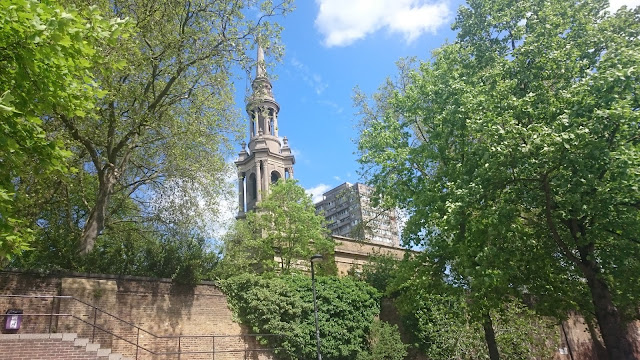 |
St Paul's church, Shadwell
|
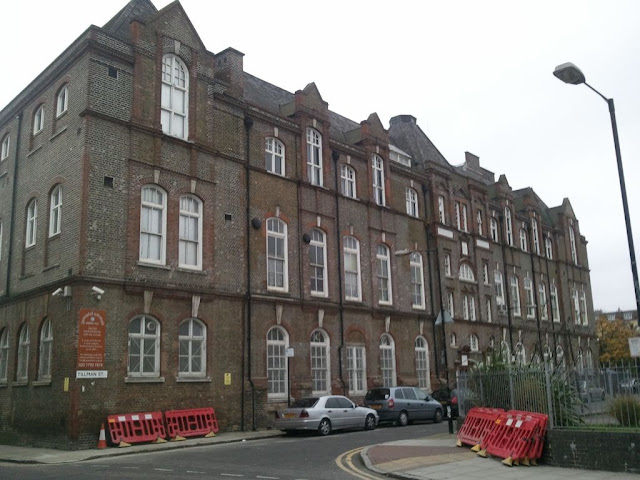 |
| Darul Ummah Mosque formally Lower Chapman Street school |
Bythe time of the next
census on 5th April 1891, Bob and his family were living at 245 Cable Street.
His father is listed as a coffee tavern house keeper. Given the nature of local
business in the area at the time, it seems likely that the house doubled up as
the business premises with the front room providing a place for customers to
sit. Bob's mother may have assisted by serving customers in between looking
after Bob and his siblings. At this time Bob had an older brother (George) and
four sisters. His older sister Sarah was aged sixteen and may have helped out
by serving customers. George aged fourteen was working as a clerk at the
council. Younger sisters Lily and Edith were at school and the youngest, Emily,
was just two years old.
At the turn of the
century Bob met a local girl named Charlotte Sherwood, who was the daughter of
a dock labourer. Once it became apparent that she was pregnant, they had to get
married. The wedding took place on 14th October 1900 at St Paul’s in Shadwell.
At that time, the twenty-one year old Bob was working as a 'commercial clerk'
and had moved from the family home in Tillman Street and was living in
accommodation at 15 Drew's Buildings, 147-151 High Street, Shadwell. As the
time of the birth drew closer the couple needed to find more suitable
accommodation. In early 1901, they were able to move to 29 Belgrave Street,
Stepney. Their son, Robert George Melton, was born shortly afterwards on 22nd
February 1901. Their new baby boy was baptised at St Dunstan and All Saints
church in Stepney on 19th March 1901.
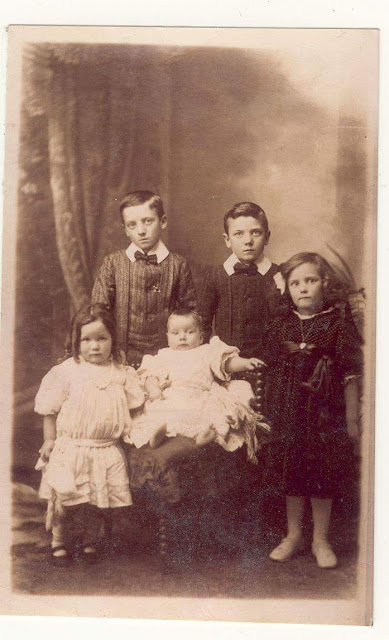 |
Photo taken circa 1911. Back row: Robert George, William Stanley.
Front row: Edith Dorothy Florence, Charles Bernard,
Winifred Edith Lily |
During the course of the
following years, Bob and Charlotte moved between a number of addresses in the
East End. Their second son, William Stanley, was born on 29th
October 1902. Baby William was baptised at St George-in-the-East on 19th
November 1902. At the time, John and his growing family were lodging with his
sister, Sarah and her husbandAlbert at 53 Anthony Street, a street that ran
south from Commercial Road just to the west of Watney Street. This was followed
by the birth of Winnifred Edith Lily in Limehouse on 15th January
1905. Little Win was baptised at St James’s church, Butcher Row, Ratcliff on 1st
February 1905. Between Win’s birth and her baptism, the family had moved to 220
Boundary Road, Barking. As the family was growing, Bob must have decided it
would be better for them to move to Essex where the air was purer and the
quality and size of the housing stock was better. On 4th December
1907 their second daughter Edith Dorothy Florence was born. Two years later on
19th March 1910 they had another baby boy named Bernard Charles. The
census of 2nd April 1911 reveals that the family had moved to 59 Saxon Road,
Ilford which was close to boundary with Barking. By this time Bob was working
as a 'shipping clerk'.
Growing tensions overseas
culminated in the outbreak of the First World War in August 1914. At the age of
thirty-five, Bob would have been too old to volunteer for the regular army.
Instead, he joined the 14th Battalion London Regiment which was a unit in the
Territorial Army. It seems that while the younger men went to fight on the
Western Front or other locations, Bob remained at home and was able to continue
his civilian life working as a 'shipping clerk'. The family expanded further
with the arrival of Kathleen Agnes Melton on 20th July 1914 and
another son, Arthur Sidney Melton, the following year. As stories of life in
the trenches filtered through, he must have been nervous about the prospect of
going overseas to fight one day.
That day arrived on 2nd August
1917. He was summoned to Whitehall and enlisted with the Army’s 56th
(London) Division before being posted to the Western Front. He first saw action
two weeks later at the Battle of Langemarck
(Inverness Copse and Glencourse Wood). This battle formed part of the
more well-known Battle of Passchendaele which was also known as the Third
Battle of Ypres. The battle’s objectives were reached, but a strong German
counter-attack threw the London Division back to its original start line.
Casualties were 111 officers and 2,794 men over a five day period in the line,
most of them as a result of the attack on 16th August. Following
these operations the division withdrew from the line, and moved south to the
Cambrai area, taking over trenches at Lagnicourt in early September.
On the opening day of the Battle of Cambrai,
20th November 1917, the division was involved in diversionary
operations opposite Moeuvres, and two days later they attacked and captured
Tadpole Copse and the Hindenburg Line near Moeuvres itself. Here they remained
in reserve while the fighting for Bourlon Wood continued. During the German
counter-attack, the positions held near Tadpole Copse were overrun and the
division forced back towards the old British front line. Casualties at Cambrai
were 211 killed, 1,046 wounded and 369 missing.
After Cambrai the London Division moved to
Arras, and took over the line between the Oppy and Gavrelle sectors.
In February 1918 Bob fell ill. His symptoms
included headaches, skin rashes, inflamed eyes and leg pains. On 21st
February he was admitted to 42 Casualty Clearing Station, which at this time
was situated close to the village of Aubigny in the Somme valley to the east of
Amiens. He was diagnosed with ‘Trench Fever’ and his condition was considered
serious enough for him to be transferred back to England on 6th
March, where he was admitted to the Birmingham War Hospital.
Bob spent almost three months in hospital.
Though ‘Trench Fever’ was not life-threatening its symptoms could be unpleasant
as well as debilitating. The patient would seem to recover only to relapse
several days later. By 1917 it was one of the more common causes of illness in
the trenches. The cause of the condition was not understood until 1918 and this
could explain Bob’s extended stay in hospital. In 1918 the cause of ‘Trench
Fever’ was identified as excretions from lice, affecting all trenches.
The disease was transmitted via the bites of body lice and was chiefly
prevalent on the somewhat warmer Western and Italian Fronts. Lice were rife in
the crowded and dirty conditions of the trenches.
On 1st June 1918 Bob was considered
well enough to be discharged from hospital. The army then sent him to Shoreham
Camp on the south coast for training. He remained at the camp until October
1918 when he returned to duty with the Army Pay Corps. By this time the Allied
forces had broken through the German lines and the First World War ended on 11th
November 1918 at 11am.
Fortunately for Bob, the ‘Trench Fever’ did
not leave him with any serious health problems when he was demobilised from the
army in 1919. However, he was still granted a disability pension on the grounds
that he suffered from occasional rheumatism.
At the end of the war, Charlotte was pregnant
again and on 19th April 1919, Alan Douglas Melton was born. After
the armistice life returned to normal and Bob returned to work as a ‘shipping
clerk’. It is likely that he would have commuted into the city using the railway
which passed through nearby Barking. At weekends he would have occasionally
used Barking Station to take his family on outings to Southend. Bob and Charlotte's youngest son, Kenneth, was born on 10th January 1921.
Bob was keen on football and became the club
trainer at Barking Town FC. He took on this role when the club was reformed
after the war and remained there until at least 1938. During his period with
the club they won plenty of silverware including the London League Premier
Division (1920/21), London Senior Cup (1926/27) and President’s Cup (1937/38).
The club played their home games at Vicarage Field which is now buried under
the shopping centre that bears the same name.
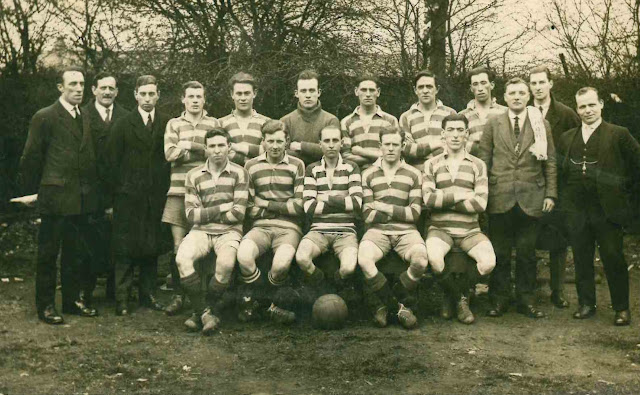 |
1921 Barking Town FC London League Winners Div 1 also Ilford Hospital Shield beat Custom House FC 5-0 at West Ham
John Robert Melton is standing 3rd from the right with a scarf draped over his shoulder |
In the twenties and thirties London County
Council bought land to the east of Barking and at Becontree near Dagenham.
London’s population was increasing and the people needed new places to live,
away from the squalor and overcrowding of the East End slums. The area of land
at Becontree was developed into the largest council estate in Europe. This
massive public spending probably helped to soften the impact of the depression
of 1929-1933. The development of the Becontree estate also resulted in the
District Line being extended east to Upminster.
In 1934/35 Bob and his family moved to 136
Stratton Drive on Barking’s newly-built Leftley Estate. House prices started
from £670 freehold with a £50 deposit. They were built with Crittall windows,
roofs were boarded and tiled, and they had a bathroom with a separate lavatory
– a luxury in those days. The house also had a relatively large garden which
enabled Bob indulge his passion for gardening. By this time Bob had risen
through the ranks of the shipping company where he worked and was now a
departmental office manager.
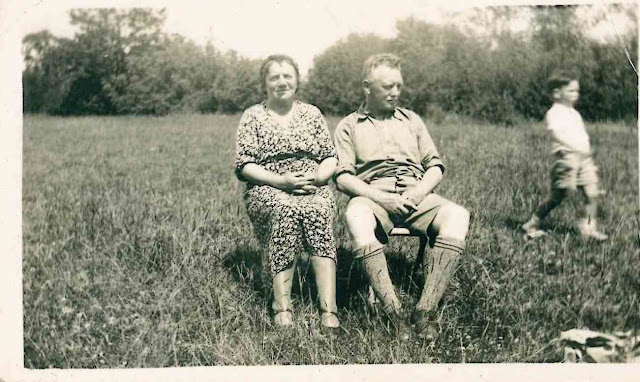 |
| Bob and Charlotte "Old Love" |
The late thirties once again saw a rise in
tensions overseas. Hitler became the chancellor of Germany and despite Prime
Minister Neville Chamberlain’s peace summit with Hitler in 1938, Britain found
herself at war in September 1939 when Germany reneged on her promise not to
invade Poland.
The government immediately put in place
measures such as the evacuation of children and the issue of gas masks, however
very little actually happened following the declaration of war. This period
became known as ’The Phoney War’.
‘The Phoney War’ came to an abrupt end in
spring 1940 when Germany invaded the Low Countries and France. The British
Expeditionary Force and the French Army were outflanked. Disaster was averted
by the miraculous evacuation of British troops from Dunkirk, but with France
under Nazi control, Britain was alone. It was only matter of time before
Germany would attempt to invade England.
The Battle of Britain had now begun. German
fighters attempted to gain control of the skies over South East England, but
against the odds the Hurricanes and Spitfires of the Royal Air Force proved to
be more than a match for the German aircraft.
On Saturday 7th September 1940 West
Ham United were playing Tottenham Hotspur at the Boleyn Ground. The Hammers
were 4-1 up and on course for a famous victory. As the match drew to a close,
the skies were darkened by hundreds of enemy aircraft approaching from the
east. This day, which came to be known as ’Black Saturday’, was the first air
raid that targeted London. The damage and loss of life was immense. The
Luftwaffe had changed their tactics.
From ’Black Saturday’ until the 20th
November there were daily and nightly air raids. Bob and his family would have
retreated to the Anderson Shelter in the back garden while the bombs fell
around them. Though the majority of the bombs fell on the East End
neighbourhoods closest to the docks, many fell in the Barking area.
As autumn turned to winter the air raids
decreased in frequency and the worst appeared to be over. The air raids did not
intensify again until early 1943 with the onset of the ‘Little Blitz’.
By 1944 there was a new menace: flying bombs
known as ‘Doodlebugs’ or ‘Buzz Bombs’. These were V1 rockets launched from the
Belgian or Dutch coast. Like other East Enders, Bob and Charlotte made the best
of it and carried on with their lives. They knew they would be alright as long
as they could hear the rocket’s engine as it passed overhead. If the buzzing
noise stopped it meant that the rocket had expended its fuel supply and it was
only a matter of time before it fell to earth and exploded.
As 1944 became 1945, London was subjected to
an even more terrifying threat: the V2 rocket. This new weapon was silent and
the first anybody knew about it was when they hit and devastated entire
streets. Initially the Churchill government tried to cover up these attacks and
would issue heavily censored photographs labelled by the caption ‘gas explosion’.
Later, as London was subjected to more attacks, the restrictions were lifted.
It is alleged that the government fed false information back to the Germans
stating that the rockets were hitting to the west of their intended target,
presumably as a means of protecting parliament and the royal family.
Consequently it was the areas to the east and south-east that bore the brunt of
both the V1 and V2 attacks. At the time
there was a large explosion over Mayesbrook Park close to Bob and Charlotte’s house. This was
attributed to a V2 rocket.
The war finally ended in
August 1945 and once the celebrations were over, the enormous task of
rebuilding London and re-housing the homeless began. By this time Bob had
retired and could spend more time in the garden. In the post war years, he
would have enjoyed relaxing and spending time with his wife and children who by
now had their own children. They were a close family and his children and
grandchildren all lived nearby.
In 1957 Bob became ill with stomach cancer and
passed away on 21st September. Bob’s son, Arthur, was present at his
death. He lived through a period of enormous change and elevated the family
from the privation of the Victorian East-End to the relative comfort of the middle-class
Essex suburbs. Quite an achievement.


