Tuesday, 21 January 2020

An infamous reverend?

St Vedast, Foster Lane
The church St Gregory in Fledborough, a hamlet by the banks of the River Trent seems a world away from our family's roots in southern and eastern England, and yet my journey back through time on the Sherwood branch of my father's side of the family has led me to this quiet backwater on the Nottinghamshire/Lincolnshire border. The vicar of this remote parish was Reverend William Sweetapple, my 7x great-grandfather.

William, the son of John Sweetapple, and his wife, Amy; was born in London on 28th March 1688 and baptised at St Vedast, Foster Lane on 10th April. The church survived the Great Fire, but the damage sustained during the disaster was severe enough for repairs to be carried out between 1695 and 1701. Brother John born a year later and sister Amy the following year.During his childhood he would have witnessed the nearby edifice of St Paul's Cathedral slowly rising from the ashes of the fire to be completed in 1708

William was admitted to Balliol College, Oxford on 21st June 1705. He graduated in 1709 with a BA, but stayed on at Oxford and graduated with an MA on 16th January 1712 at the age of 23. His career in the church began later that year when he was ordained as a deacon at Christchurch cathedral, Oxford on 16th May. Six weeks later, on 29th June, he was at Bishopsthorpe Palace in York being ordained as a priest and he was appointed as the rector of Fledborough.

Family tree from great-grandmother, Charlotte Sherwood, back to to William Sweetapple


Fledborough's population of just 60 people meant he would have to wait until 1715 before performing his first marriages at the parish church of St Gregory. Two more marriages took place in 1717, and then on 23rd June 1721 his own marriage, to Elizabeth Chapman, took place there.

Their first son, William was born in 1724, but sadly died at the age of 2. He was buried in the churchyard on 13th 1726. That same year, they had a daughter, Amy and in the years that followed they had 3 more children; Elizabeth (1729), Edward (1731), Caroline (1733) and John.

His father died in 1727 and may have received a substantial inheritance. That same year he took local landowner and nobleman Evelyn Pierrepont, 2nd Duke of Kingston, to court in a dispute over tithes, glebe land and right of common. The action, brought at Serjeant's Inn in London's Fleet Street, succeeded and he was permitted to assert his right to the glebe land and right of common.

Legal action at Serjeant's Inn
Between his marriage and his death in 1755, Rev. Sweetapple performed a further 8 marriages for which the banns had been called conventionally in church, but during this period he also solemnised an astounding 488 marriages by means of licences which he had issued himself, having been empowered by the bishop to issue surrogate ecclesiastical marriage licences in 1728. As you can imagine, this ruffled a few feathers in within the church establishment. Writing in 1950, Frank West, the Archdeacon of Newark said ‘gradually it became known that in this snug little hamlet on the banks of the Trent, an ideal spot for a clandestine marriage, there was an obliging parson who would grant a licence without asking awkward questions at the rectory one moment, and perform the marriage ceremony in the church at the bottom of his garden ten minutes later…From Bawtry to Bingham and from Mansfield to Newark, every apprentice who was plotting to run away with his master’s daughter, every reckless young scapegrace who had persuaded an heiress to elope with him knew that he would find a willing accomplice in the…rascally Mr Sweetapple’.

Despite the accusations, research shows the truth may have been somewhat more prosaic. It is true that several spouses came from considerable distances to marry in Fledborough, such as William Belyeat from the Isle of Ely; Robert Slainey, a widowed brick-maker, from Bolsover; Francis Spencer, a joiner, from York, Lydia Style from Buckinghamshire and Anne Calvert from Doncaster. However, these were the exceptions. 33% of grooms and 38% of brides came from within five miles of Fledborough, and only 4% of grooms and 3% of brides originated from more than twenty miles distant. The average ages at which the licensees married was also fairly typical for the period, being 26 for men and 24 for women, so it was not the case that only young people were flocking to Fledborough. There were also relatively few of the gentry, and at the opposite end of the social spectrum, few labouring people – the majority of his clients appear to have been relatively local, middling farmers, tradesmen and craftsmen. Interestingly, there were 4 mariners, 2 ferrymen, a bargeman, a waterman, and a sea-captain, pointing to Fledborough’s location near the River Trent.

The marriages solemnised by Rev. Sweetapple were ‘clandestine’ in the strictest sense of the word, in that they probably breached aspects of matrimonial law, particularly the canon which stated that either the husband or wife should live in the parish where the wedding took place. The marriages he performed by licence infringed these rules, but the ecclesiastical authorities must have turned a ‘blind eye’ to his activities and he was never accused of malpractice.

The reason so many people went to the considerable trouble of marrying at Fledborough remains an enigma. Sweetapple may have a had a reputation for being more accomodating, or he may have charged less for the licence, but Outhwaite concludes that ‘it may also be the case that the chief attraction was Fledborough's relative isolation: it was off the beaten track. If privacy was the quality licence seekers most desired, then this lowly populated Trent-side parish could certainly offer it’. It's not clear how Sweetapple himself benefited. He died a relatively wealthy man and in his will left £500 and silver to his daughter Elizabeth, £200 and more silver to his daughter Caroline, silver to his son John and land to his son Edward and smaller monetary gifts to his son-in-law and grand-daughter.

Sweetapple died in 1755, the year after the surrogate power to issue ecclesiastical marriage licences had been withdrawn. He and his wife are buried in the church.


St Gregory, Fledborough, Nottinghamshire

Monday, 6 January 2020

From silk weaver to pewterer - the story of Matthew Collier


My 4× great-grandfather, Matthew Delves Collier was born on 14 November 1797 in Shoreditch, Middlesex, the first born child of William Delves Collier, a silk weaver, and his wife Eleanor. He was baptised on 18th September 1798 at St Leonard's church Shoreditch and at the time the family were living in Spencer Street off New Inn Yard.


Baptism record (St Leonard's church, Shoreditch)
In the years that followed, the family grew quickly with the arrival of siblings Sarah, Ann, Eleanor, John and Amelia by the time he was 7 years old. The following year, the family moved the short distance to the growing suburb of Bethnal Green, and by the time he was 16, in the year 1814, he had 5 more brothers and sisters: James, Thomas, George, Caroline and Jane. By then, Matthew was working at a pawnbrokers shop in Berwick Street, Soho owned by a Mr and Mrs Alders and his contribution to the family finances would have helped them keep food on the table and a roof over their heads. It must have been difficult to make ends meet and the temptation to make some easy money must have been strong. So strong that on 23rd October 1814 he stole a shirt, a handkerchief, a pair of gloves and a pipe reed from his employers. Three days after the incident, he was before a judge at the Old Bailey and was found guilty. However, after calling two witnesses that provided testament to his good character, he got away with a 1s fine and was discharged. The court transcript is below:

MATTHEW COLLIER was indicted for feloniously stealing, on the 23rd of October , a shirt, value 4 s. a handkerchief, value 1 s. a pair of gloves, value 18 d. and a pipe reed, value 2 s. the property of Elizabeth Ann Alders and James Alders .

JAMES ALDERS . I am a pawnbroker . The prisoner was my journeyman . I lost the things, and on the 23rd of October I found them in the prisoner's possession; I missed them from Berwick-street, Soho. On the 12th of October, a person applied for a pair of stockings pledged with us, and on searching the book, it appeared redeemed; I could not find them. I sent for an officer, and the things were found in the prisoner's box.

WILLIAM CARVEN . I am an officer. I took the prisoner into custody. The shirt and handkerchief he had on, the other articles were in his box. This is the pipe reed. I produce the property.

Prosecutor. They are my property; the pipe reed was an article that we had in the window for sale.

The prisoner called two witnesses, who gave him a good character.

GUILTY , aged 16.

Fined 1 s. and Discharged.


Second Middlesex Jury, before Mr. Recorder.

It seems that his brush with the law put him off engaging in any further criminal enterprises and less than 5 years later he was married. He wed Elizabeth Richards at St Matthews, Bethnal Green on 1/08/1819 and the couple were soon blessed with children. Their first son, Matthew Delves, was born on 11th August 1820 and he was joined by Samuel on 27th December 1821. Both sons were baptised at St Matthews, Bethnal Green and at the time, Matthew was working as a weaver and the family were living in Hope Town, a newly-built area of Bethnal Green situated to the north of Church Road/Bethnal Green Road.


Extract from Greenwood's map 1827 showing Hope Town
The family doubled with the arrival of two daughters: Eliza Elizabeth on 2nd October 1824 and Clara Louisa on 12th May 1827.

At the time, the theft of recently buried corpses was prevalent in the area. In a bid to deter the body snatchers, a watchhouse was build at the corner of St Matthews churchyard in 1826. However, with corpses for dissection being in high demand at London's teaching hospitals, the crimes continued. Nova Scotia Gardens, just a few streets away from Matthew's home, became the centre of the most notorious case of body snatching in London. In 1831, a young boy thought to be of Italian descent was seen screaming and waving for help by John King and his 11 year old sister Martha as they hung the washing out at their home in Crabtree Road. The boy was thought to be Carlo Ferrero, and came to be known as the 'Italian Boy'. He was the first known victim of the 'London Burkers'. The gang were eventually caught and the ringleaders, John Bishop and Thomas Williams, were hanged outside Newgate Prison on 5th December 1831.

The Spitalfields Acts which had protected the local silk weaving industry were repealed in 1824. This lead to an influx of cheaper silk imports from the 1820/30s which undercut the local workforce and resulted in widespread poverty. In response to this, Matthew evidently retrained as a pewterer and by 6th June 1841, the family were living above the Jolly Weavers pub at 60 Wheeler Street, Spitalfields. Matthew, his wife Elizabeth and their children (Clara) Louisa and James lived there along with the landlady's family.  


1841 census
His wife, Elizabeth, died in late 1846 and was buried at St Matthews, Bethnal Green on 31st December. The whole area was going through enormous changes at this time. Several years earlier a new railway terminus for the Eastern Counties Railway was built on the eastern side of Bishopsgate and on the late 1840s the slum housing was cleared to make way for Commercial Street that ran northwards from Whitechapel. 

At the turn of the decade, Matthew remarried. His new wife, Susan Cooper was considerably younger than him at just 29 years old. The wedding took place at St Mark's church, on the corner of Old Street and City Road, on 10th March 1850. The census taken the following year shows the couple were living at 11 Charlotte Street.


Extract from 1851 census
In the autumn of the following year, the couple had a child. Susan Collier was baptised at St Bartholomew's church, Bethnal Green on 17th October 1852. By this time the family had moved to 4 Tapp Street, close to the railway station and two doors down from a pub called The Lion, which over a century later, became associated with the Kray Twins. By this time, Susan was already suffering frequent bouts of coughing due to Phthisis (Tuberculosis). Her illness worsened as autumn turned to winter and she died at home with Matthew by her side on 13th February 1853. She was laid to rest at St Bartholomew's church on 22nd February.  


Susan Collier death certificate


St Bartholomew the Less, Bethnal Green

The following year, Matthew married for the third time. His new bride, Mary Smith, was a widow and much closer to his own age. The wedding took place at St Bartholomew's in 17th April 1854. 

Seven years later, Matthew, his wife Mary and their 8 year old daughter were living a short distance away at 47 Wilmot Street. Matthew is incorrectly named 'Joseph' on the 1861 census, but it must be him because all the other details are correct.


In the years that followed, it's likely that Matthew became progressively more forgetful and may have struggled to undertake even basic tasks. Unable to cope, his wife approached the local poor law authorities for help. After assessing his case, Matthew was removed from his home at 18 Seabright Street in 1870 to the local workhouse infirmary and after a short stay there, was taken to he newly-built Leavesden Asylum in Hertfordshire. By October of the following year there were 739 male and 899 female patients. According to the 1881 census recorded a local population of 3,643.


1881 census - Leavesden Asylum
The 1881 census describes Matthew as a 'lunatic' and although this is a derogatory term by today's standards, in Victorian times it had more of a medical connotation. A lunatic was someone who sometimes had good and sound memory and understanding, and sometimes did not. Similarly, an imbecile was someone with the mental age of an infant.

Patients at the asylum who were capable of working were taken under strict supervision to various areas. The women worked in the laundry, needleroom and the female staff quarters. Men worked in the gardens, on the farm, in the shoemakers, tailors, upholsterers and paint shops, and in the laundry kitchen and bakehouse. Patients who were unsuitable for these jobs were employed on the wards scrubbing and corridors and stairs. 
Leavesden Asylum
Patient's clothing was made on the asylum premises: men's corduroy suits in the tailor's shop, and women's dresses in the needleroom. Neckerchiefs were issued to the men and bonnets and shawls to the women. At night, all clothing was taken out of the dormitory and kept in a room at the end of the ward. The men wore day shirts and vests at night. 


Recreation was considered an important part of the patient's life. However, discipline was strict. The sexes were segregated, apart from the weekly dance and chapel service, but even then, women were made to sit on one side and men on the other.


Register of death

The asylum was Matthew's world for the last 16 years of his life until his death due to bronchitis on 24th December 1886 at the age of 89. He had probably been suffering from dementia for around 20 years, a disease which may have been caused by working with pewter, which in those days, contained lead.


Monday, 16 December 2019

Richard the Cattle Salesman

Snow family tree


Richard Arnold Snow was born in Braintree, Essex and baptised at St Michael the Archangel church on 15th June 1826. He was the son of Thomas and Elizabeth Snow and Thomas, who 
was originally from the village of Great Waltham, was a pig dealer. His mother Elizabeth, who had been born Elizabeth Arnold, was originally from nearby Kelvedon. The couple had been married for 2 years at this point and already had a daughter, Eliza.

Baptism record
Richard had an older sister, Eliza and there could have been other older siblings who may not have survived infancy. We do know there were two surviving younger siblings. Richard’s younger brother Thomas arrived when Richard was 10 years old. Thomas was followed by a sister, Ann, two years later. Richard apparently spent his childhood growing up in Braintree and certainly by 1841 they were living in New Street close to the centre of the town. 

As a pig dealer, Richard's father would buy livestock either from local agricultural fairs or directly from farmers. In the 1840s and prior to the development of the railways, these animals were transported across the country on foot. They would be fitted with iron shoes rather like horseshoes and walked long distances accompanied by the salesmen and their assistants, the drovers. Depending on the season, the pigs would be sold on at markets to be slaughtered or lead to pasturelands to be fattened up. The job involved staying away from home and travelling great distances. 

In August 1844, when Richard was just 18 years old, his father passed away. The funeral took place on 15th August at the church of St Michael the Archangel in Braintree. This event, as sad as it was, would have been one of the most important events of his life. We don't know what happened in the immediate aftermath of his fathers death, but four years later the Post Office Directory shows that he had moved to London and was running a ham and beef shop at 34 High Holborn. His business is also listed in the 1850 P.O. Directory, However, by the time of the census the following year the 25 year old Richard was lodging at 21 Ormsby Street in Shoreditch and was reduced to sharing a room with a 21 year old wood block carver in a house run by a widow named Elizabeth Baines. She lived on the premises with her sister and nephew with Richard and the wood carver occupying one of the rooms with the remaining room containing two further lodgers. His business 
the business had evidently failed as he was now working as a cattle salesman, similar to his father. 


Ormsby Street 1976
It was probably whilst living here that met a young woman who made such an impression on him that they decided to get married. His young fiancée was called Clara Collier. Clara was a year younger than Richard and was the daughter of a pewterer who was descended from silk weavers. She had grown up in Shoreditch. Richard and Clara married at Hackney parish church on 8th August 1852. 

After the wedding, Richard and Clara remained in Shoreditch, possibly with her family, but it wasn’t long before they started a family of their own. Their first daughter, Clara, was born in the spring of the following year. She was followed by Eliza who was born in the early months of 1855. Unfortunately, by this time Richard's past business debts had caught up with him and he was forced to apply for an interim order at the court for the relief of insolvent debtors in a bid to try and prevent legal proceedings against him. The order required him to attend a hearing at the court house in Portugal Street, Lincolns Inn so that any mitigating circumstances could be assessed. Richard attended the court on Thursday 1st March 1855 at 11am and whatever he said on that morning must have kept him out of debtors prison as there is no record that he was ever incarcerated. 


Extract from the London Gazette

The article above describes Richard as a salesman's assistant and a licensed drover. In those days the hours during which cattle could be moved through the streets were strictly regulated. No cattle were permitted to be driven to Smithfield Fair before midnight on a Sunday, while it was forbidden to drive animals within one mile of Smithfield before 11 pm on market days. Anyone breaching these rules could be prosecuted. It was possible, however, after 1867, to drive cattle through the streets of London, provided the prior permission of the police commissioner had been obtained. Such regulations applied both to local city drovers and to those persons bringing cattle from afar. Public concern with the barbaric ways with which the city drovers frequently treated their cattle prompted the Mayor's Court to issue an ordinance forbidding drovers from using '. . . any stick or other instrument the point of which shall be of greater length than one quarter of an inch ‘. Any drovers caught using sticks which had not been approved by the Clerk of the Court and marked accordingly, could be fined a sum up to forty shillings.


Birds eye view of Smithfield Market

In Oliver Twist, which Charles Dickens wrote in the late 1830s, he described Smithfield as being covered "nearly ankle deep with filth and mire: a thick steam perpetually rising from the reeking bodies of the cattle" with it's "unwashed, unshaven, squalid and dirty figures", the market was "a stunning bewildering scene which quite confounded the senses" Dickens' account gives us a good idea of what Smithfield must have been like when it was a 'live' meat market, when cattle were driven to market to be slaughtered on site. It was not until 1855 that the 'live' meat market was moved further north to Copenhagen Fields in Islington.

Richard's first son, Richard, was born in early 1857, they had moved to a place of their own in Hackney. 
Records suggest they remained in Hackney for about three and a half years before moving slightly further east to Homerton, which at the time still had a rural atmosphere. They moved into Geranium Cottage at no.3 Sydney Road at the junction with Marsh Hill. Marsh Hill, as the name implies, was the eastern extension of the High Street that lead downhill out of Homerton towards Hackney Marshes. The marshes were used at certain times of year under Lammas rights as grazing lands and this was probably an important factor in Richard’s decision to move to the area. Homerton also had decent amenities. At the time shops, lined both sides of the High Street and there were seven public houses. 
Homerton High Street c1870

Not long after moving there and at some time during the final months of 1860, Clara gave birth to twins whom they named Algernon Robert and Susan Catherine. Richard seems to have been making a success of his life as a cattle dealer because not only had he managed to move his family out to the relatively leafy suburbs, but he could also afford to employ a young servant girl. Richard and Clara’s third son, Walter, was born on 11th January 1863. His birth was followed by more children: Sarah Jane in spring 1865 and William James in the summer months of 1868.

The 1860s were not all plain sailing for Richard. In 1867 there was a nationwide outbreak of cattle plague which would have lead to restrictions in the movement of cattle. The Times newspaper for 12th September 1867 contains an article reporting a fresh case of the disease on Hackney Marshes. The unfortunate animal died along with 278,927 others across the country during the course of the outbreak. In addition to these deaths, the government’s veterinary office culled a further 56,911 healthy cattle in a bid to prevent the spread of the disease. This must have damaged Richard’s business and this may have been a period of hardship for him and his family. The other significant event of the decade was the opening of Homerton railway station in 1868. This was to be the catalyst for much speculative land development and spelled the end of rural Homerton. In spite of these challenges, Richard and his family remained at Geranium Cottage and he even had time to indulge in one of his favourite hobbies: fishing. The Chelmsford Chronicle dated Friday 13th November carried the following article:


By the time of the 1871 census, Richard was working as a cattle drover and as such, probably spent periods away from home. His daughters Clara and Eliza had grown up and were working as teachers and his younger children were attending school. 
1871 census
They remained at the house on Marsh Hill until at least 1874 (there is an entry in the local street directory for them that year). Around that time the open land south of Marsh Hill was being developed so that Homerton was now connected to Hackney Wick, which was itself becoming something of an industrial centre. This lead to an influx of poor labourers who were crammed into hastily built overcrowded dwellings. Social decline set in and it was time for the Snow family to move on, however problems persisted. Heavy rains in both November 1875 and in April 1878 lead to large scale flooding as the River Lea burst its banks. The Times newspaper of 12th April 1878 describes Hackney marshes as “…a vast lake, dotted here and there by a tree or a house, access to which was only possible by boats.” The drainage which fed into the River Lea had nowhere to go and consequently basements of houses in Hackney and Homerton became flooded. 

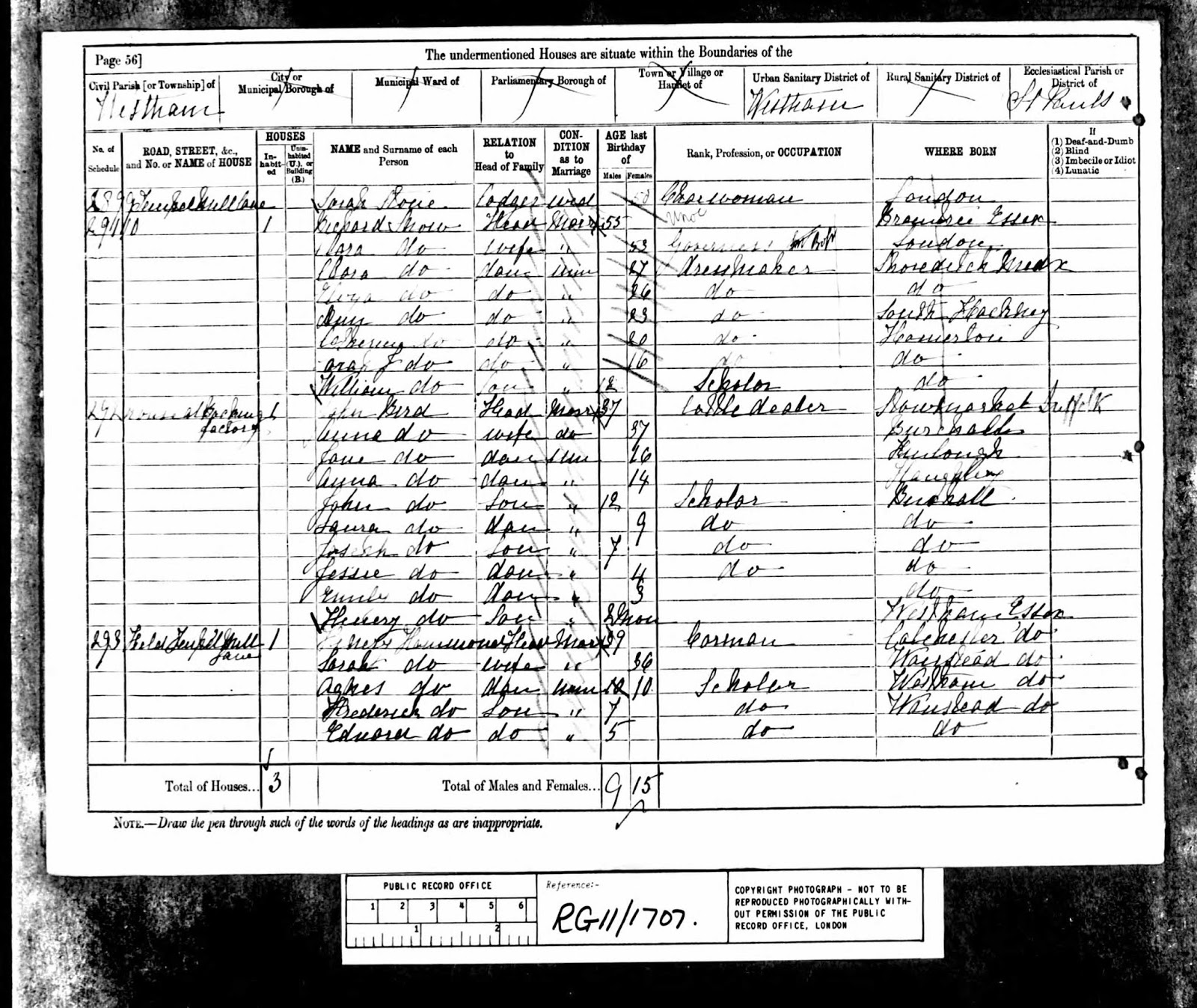
1881 census
Whether it was the flooding or the gradual social decline of Homerton we shall never know, but by the spring of 1881 the family had moved across the River Lea to Essex and were residing at 10 Temple Mill Lane, West Ham. Richard is described as “unoccupied” so perhaps his livelihood had suffered as a result of the floods. To compensate for the loss of income, his wife, Clara, had taken employment as a governess and his daughters were earning money as dressmakers. His son, William, was at school but his older sons had all left home to find their own way in the world.  However, two years after the census tragedy struck the family as Richard's son, Algernon, died. He was laid to rest at West Ham Cemetery on 18th December 1883. He was just 23 years old. 

In the years that followed, Richard’s livelihood eventually recovered and he resumed work as a cattle salesman. This turn around in fortune made it possible for him to leave the increasingly dirty and industrialised surroundings of Temple Mills to a more salubrious neighbourhood. They moved to 114 Olinda Road in Stamford Hill. At the time Stamford Hill was already growing in population due to the migration of the more successful people from the East End and it already had a small but growing Jewish community. Unfortunately for Richard, just as his economic situation was improving, he started suffering from ill health and he was diagnosed with heart disease. Richard died a year after his diagnosis, on the 12th April 1890, with his daughter Anne by his side. He was 64 years old. The family laid him to rest in West Ham Cemetery alongside his son, Algernon.


Wednesday, 11 December 2019

Ted the Carpenter


River Tamar map


When grandma was alive, she often mentioned that her mother's parents were from the West Country and since embarking on my research in 2007, I have proven this to be entirely true. In fact, I have managed to trace the Cornish branch of the family back as far as the 16th Century and plan to reveal more about this in the coming months.

This blog article describes the life of Edward Deacon, who was born in the Cornish village of Cargreen, on the banks of the River Tamar, in 1829. He was baptised at parish church in Landulph on 13th December 1829 and according to the records, his father, John, was an agricultural labourer.


Edward Deacon was the second son of John and Jane Deacon and when he was a small boy his parents decided to move the family away from Cargreen. One day they boarded a boat and sailed downriver to East Stonehouse on the Devon bank of the Tamar close to Plymouth. Here, Edward settled into a new home with his parents; older brother, James and older sister Mary Ann. The family settled in and before long Edward had a new younger brother and sister to play with. Jane Deacon was born around 1834 and John in around 1836. When it was time for them to be baptised they made the short journey back across the river to the parish church in Landulph.


By the time the census was taken on the night of the 6th/7th June 1841, Ted was living on Brownlow Street in East Stonehouse with his parents and siblings. His father, John Rouse Deacon, was working as a labourer at the time and apparently liked to drink. Life in the Deacon household may have been quite fraught at times during the 1840s. One imagines Ted’s mother, Jane, having to be the head of the family while her husband was befuddled with alcohol. In the end his drinking caught up with him and Ted’s father died at home of liver disease on 17th October 1848. At the time of his death, Ted was eighteen years old. The family arranged for the coffin to be transported upriver and he was buried at Landulph parish church on 22nd October.

Extract from 1851 census


By 30th March 1851 life for the Deacons had changed. Ted’s mother ran a horse and cart business and Ted’s older brother, James, was a “cart man”. They were probably conveying goods to and from Devonport docks which were accessible via a toll bridge over Stonehouse Creek. Ted was now 21 years old. He had trained as a carpenter and would have recently completed his apprenticeship. Ted’s younger sister Jane, aged 18, was employed as a domestic servant. Meanwhile his youngest brother John Rouse was attending school. The family were still living at 17 Brownlow Street, East Stonehouse.

By 1849 Plymouth had been linked to the growing railway network. This enabled travel by train to London for the first time via the South Devon Line and the Great Western Railway. Work commenced on a new railway bridge over the Tamar linking Devonport with Saltash. Plymouth, Devonport and Stonehouse were lit by gaslight, the gas for which was produced at the works on the road linking Plymouth with Devonport. The population of Stonehouse had increased to 9712 by 1848.

Marriage record
All Souls, Langham Place
In the early 1850s Ted met a girl named Ann Maria Stacey and they fell in love. Ann was the daughter of John Stacey, a labourer from Torpoint in Cornwall. What happened next is unclear, but one family story alleges that Ann was engaged to another and there was some doubt as to whether they could continue seeing each other. Matters came to a head when Ann became pregnant and it seems they fled to London to elope. They were married on 9th April 1854 at All Souls Church, Langham Place, Marylebone. There were apparently no members of their respective families at the wedding service.  If the above story is true, they probably lost the baby or it died in its infancy as there is no record of that child surviving until the next census in 1861. In time their families probably forgave them. 

After a while, Ted and Ann managed to acquire enough money to buy the lease on a house. They moved into 46 Clarence Gardens, St Pancras in the mid 1850s and started a family together. The house was situated close to the eastern side of Regents Park. Ann became pregnant again and when it was time for the birth, she travelled back to Torpoint in Cornwall to be with her parents for the “lying in” period. John Rouse Deacon was born there on 16th April 1856. His birth was followed by another son whom they named Edward Deacon in around 1860. The census taken the following year shows that Edward was working as a joiner which, according to the Victorian journalist Henry Mayhew, was "a man who works in a building, and usually at a bench, at everything the plane goes over, such as doors, windows, sashes and frames, closets, skirting, flooring - in fact, the joiner is the preparer, fixer, and finisher of a building." Living with the family was a 22 year old dressmaker from Norfolk named Emily Ruden. At the time, around three-quarters or four-fifths of all carpenters were from the country, so Edward was fairly typical in this respect. Wages in London were double those paid back in the West Country, so that explains why Edward relocated.
Clarence Gardens
In the 1860s they had two more children, both daughters. Annie Maria Deacon was born in the spring of 1864 and Lillian Deacon was born around 1869. They continued living at 46 Clarence Gardens and by 1871 Edward had specialised as a blind maker and his son, John, was now a carpenter's apprentice.

Extract from 1871 census
In autumn of 1874 Ted’s mother fell ill and passed away. This sad event would have necessitated a trip back to Plymouth for the funeral. By this time Ted himself was ill and was prone to frequent bouts of coughing. He would have been advised by his doctor that he was suffering from consumption (Tuberculosis). Unfortunately, his condition worsened and on 29th September 1875 he died. Rather unusually, he was buried the same day as his death at Highgate Cemetery.


Following his death, 46 Clarence Gardens passed to his wife, Ann, who continued living at the property. Census records for the 1881,1891 and 1901 suggest that she earned an income by renting out the rooms to various people. She eventually died in 1902 and was buried alongside her husband in Highgate Cemetery on 20th May.
Parents of Daisy Eveline Hewitt and her mother's lineage back to Edward Deacon


Monday, 9 December 2019

John the Artist


When the enumerator arrived at the doorstep on 6th June 1841 it must have come as something of a surprise to John. Forgetting it was census night, he had taken the family over to the home of Elizabeth Mitcham on Unicorn Hill for the evening. Along with eight thousand or so other people in the village of Redditch, Elizabeth was a needle-maker. In fact the village was famous throughout the country for the manufacture of needles and fish hooks. John enjoyed a much less mundane occupation. He was an artist. John’s house and studio was on nearby Fish Hill. He lived there with his wife Mary Ann and their two children Matthew and Dominick.
John had been with his Irish wife Mary Ann (or Marian) for thirteen years. The couple were married at the parish church of St Alkmund in the village of Duffield near Derby on 23rd November 1828. John Evans Hand was originally from Dudley in Worcestershire, but the most credible record of his baptism is from the Mares Green Independent Chapel in nearby West Bromwich dated 3rd June 1804. This states that he was born on 22nd April 1804 and that his parents were John and Sarah Hand. It is possible that his parents were subsequently married in Birmingham just under a month later as it is recorded that a John Hand married a Sarah Evans at St Martins close to the city's famous Bull Ring on 1st July 1804.
Just under two years into his marriage, John's name appeared in the Derby Mercury. The edition dated 24th February 1830 states:
 We don't know whether he ever got his bag and watercolour paints back but what we do know is that shortly afterwards his son, Matthew Samuel Hand, was born. Another son, Dominick, arrived four years later, but by then the family had moved back to a city which may have been familiar to him from his childhood - Birmingham. Wrightsons directory for 1839 shows John Hand, a portrait painter, residing at 9 Marshall Street, but for some reason the family felt compelled to move to Redditch by the time of the 1841 census.
Portrait painting was the early Victorian equivalent to having your photograph taken at a studio and may have helped keep food on the table when his other art commissions dried up. Moving regularly may have helped John escape his creditors when he fell on hard times. 
Their third son, Peter, was born at the parish workhouse in the nearby village of Tardebigg on 22nd February 1842. In the days before the National Health Service, it was common for women to give birth in the workhouse, particularly if the birth was difficult and it wasn't necessarily an indicator of poverty.  
By 1846, John and his family had returned to Birmingham and their fourth child, Mary Ann,  was born on 7th January.  At the time, the family were residing at 24 Lower Hurst Street. Mary Ann was baptised at St Peter's RC chapel off Broad Street on 1st February 1846.  The chapel was demolished in 1969 and the site now lies below the International Convention Centre. That same year, John was fortunate enough to have a piece of artwork exhibited at the Birmingham Society of Artists in Temple Row. His painting, entitled "Portrait of a Gentleman" was displayed in the vestibule:


On the back of this success, the family’s financial situation was evidently on a more stable footing by the late 1840s. Indeed, the local directories for 1849 and 1850 show that he was still at 24 Lower Hurst Street. John and Mary Ann's 5th and final child, a daughter named Elizabeth, was born on 3rd July 1849. Like her elder sister, Elizabeth was baptised at the St Peters RC chapel on 22nd July 1849. 
One explanation for the improvement of John’s financial affairs is that Birmingham had become a boom town. The industrial revolution had resulted in Birmingham becoming one of the leading manufacturing centres in the country. A new middle class was emerging and these people could afford to spend money having their portrait painted. The wealthiest people, the factory owners and rich merchants, financed the art world and as a result there was a growing artist community in the town. Another factor that could explain the improvement in the family’s financial position is that John’s two eldest sons were now old enough to work and contribute to the family’s income.
There was a darker side to life in Victorian Birmingham. The cramped and unsanitary conditions in the more working class neighbourhoods lead to an outbreak of cholera in 1849 which claimed many lives. In the following year Birmingham was the scene of anti-catholic rioting when the Pope reinstated the Roman Catholic religious hierarchy in England by making Cardinal Wiseman the head of the church in England.


By the time of the 1851 census John and his family had moved to 24 Broom Street in the Bordesley area of Birmingham. Matthew was working as a ‘house painter’ and Dominick was employed as a ’rule maker’. Both Peter and Mary Ann were attending school.
In the summer of 1852, John’s son, Matthew, got married Sarah Gawthorp. Sarah was from Southwark in Surrey. Two years later, his other son, Dominic, married her sister Nancy. Following their weddings the sons and their wives probably lived under the same roof as John, however once they started having children of their own the house must have become overcrowded. The lack of space prompted Matthew and Dominic to move south to Southwark with their wives and families to begin a new life by around 1857.
Shortly after the departure of his two eldest sons, John and the remaining members of his family started a new life of their own in Lancashire. According to the 1861 census they were living at 2 River Place, Salford. John was still working as an artist, his wife Mary Ann was employed as a dress and mantle maker and Peter was working as a stone carver. Elizabeth was at school but John’s daughter Mary Ann was not at home. She was in fact working as a domestic servant at the Cross Keys, a local public house, on that particular evening.
Why did they move again? The following scenario may have been a factor: from the 1850s onwards photography was developing and becoming more widely available. Photographic studios were opening and people chose to have portrait photographs produced rather than a portrait painted. This would have been bad news unless John could adapt his skills. In addition, the departure of his two eldest bread-winning sons John’s financial situation probably took a turn for the worse. Secondly, the art scene in Manchester was growing. On 5th May 1857 a fine art exhibition opened in a specially commissioned wrought iron building in Old Trafford. The exhibition was financed by local manufacturers and businessmen.
In the end, the move north did nothing to ease John’s financial concerns in the long term and it seems he moved down to London in 1861/62. With little or no money, the most likely scenario is that he either moved in with Matthew or Dominic, or perhaps they lodged in cheap rented accommodation nearby. What we do know is that by April/May 1862 John had fallen seriously ill. His illness probably started with a fever and body aches. This was followed by a rash several days later. At this point he would have been admitted to St Thomas’ Hospital and in the days that followed his condition deteriorated with the onset of pneumonia and kidney failure. He died in hospital on 15th May 1862.


The cause of his death was Typhus fever. Typhus fever was not uncommon and epidemics occurred throughout the 19th century. The disease was transmitted by body lice, which were widespread in the cramped working class housing of the day. John probably contracted the disease after being bitten. It was a tragic end for a creative man whose life had been afflicted by financial uncertainty. His legacy would have been the paintings he produced. Sadly none of these are known to have survived.